ABOUT a year ago, I flew to Singapore to join the writer Malcolm Gladwell, the fashion designer Marc Ecko and the graphic designer Stefan Sagmeister in addressing a group of advertising people on “Marketing to the Child of Tomorrow.” Soon after I arrived, the chief executive of the agency that had invited us took me aside. What he was most interested in, he began — I braced myself for mention of some next-generation stealth campaign — was stillness.
A few months later, I read an interview with the perennially cutting-edge designer Philippe Starck. What allowed him to remain so consistently ahead of the curve? “I never read any magazines or watch TV,” he said, perhaps a little hyperbolically. “Nor do I go to cocktail parties, dinners or anything like that.” He lived outside conventional ideas, he implied, because “I live alone mostly, in the middle of nowhere.”
Around the same time, I noticed that those who part with $2,285 a night to stay in a cliff-top room at the Post Ranch Inn in Big Sur pay partly for the privilege of not having a TV in their rooms; the future of travel, I’m reliably told, lies in “black-hole resorts,” which charge high prices precisely because you can’t get online in their rooms.
Has it really come to this?
NY Times
January 6, 2012

December 9, 2011
H&M Puts Real Model Heads On Fake Bodies

The bodies of most of the models H&M features on its website are computer-generated and "completely virtual," the company has admitted. H&M designs a body that can better display clothes made for humans than humans can, then "dresses" it by drawing on its clothes, and digitally pastes on the heads of real women in post-production. For now — in the future, even models' faces won't be considered perfect enough for online fast fashion, and we'll buy all of our clothing from cyborgs. (This news sort of explains this.) But man, isn't looking at the four identical bodies with different heads so uncanny? Duly noted that H&M made one of the fake bodies black. You can't say that the fictional, Photoshopped, mismatched-head future of catalog modeling isn't racially diverse.
Jezebel
October 7, 2011

September 26, 2011
From the man who discovered Stuxnet, dire warnings one year later
One year ago a malicious software program called Stuxnet exploded onto the world stage as the first publicly confirmed cyber superweapon – a digital guided missile that could emerge from cyber space to destroy a physical target in the real world.
It took Ralph Langner about a month to figure that out.
While Symantec, the big antivirus company, and other experts pored over Stuxnet's inner workings, it was Mr. Langner, an industrial control systems security expert in Hamburg, who deciphered and tested pieces of Stuxnet's "payload" code in his lab and declared it a military-grade cyberweapon aimed at Iran's nuclear facilities.
Days later, he and other experts refined that assessment, agreeing Stuxnet was specifically after Iran's gas centrifuge nuclear fuel-enrichment program at Natanz.
After infiltrating Natanz's industrial-control systems, Stuxnet automatically ordered subsystems operating the centrifuge motors to spin too fast and make them fly apart, Langner says. At the same time, Stuxnet made it appear random breakdowns were responsible so plant operators would not realize a nasty software weapon was behind it.
Christian Science Monitor
It took Ralph Langner about a month to figure that out.
While Symantec, the big antivirus company, and other experts pored over Stuxnet's inner workings, it was Mr. Langner, an industrial control systems security expert in Hamburg, who deciphered and tested pieces of Stuxnet's "payload" code in his lab and declared it a military-grade cyberweapon aimed at Iran's nuclear facilities.
Days later, he and other experts refined that assessment, agreeing Stuxnet was specifically after Iran's gas centrifuge nuclear fuel-enrichment program at Natanz.
After infiltrating Natanz's industrial-control systems, Stuxnet automatically ordered subsystems operating the centrifuge motors to spin too fast and make them fly apart, Langner says. At the same time, Stuxnet made it appear random breakdowns were responsible so plant operators would not realize a nasty software weapon was behind it.
Christian Science Monitor
August 31, 2011
August 22, 2011
Nuns, a ‘Dying Breed,’ Fade From Leadership Roles at Catholic Hospitals
When Sister Mary Jean Ryan entered the convent as a young nurse in 1960, virtually every department of every Catholic hospital was run by a nun, from pediatrics to dietary to billing. After her retirement on July 31 as the chief executive of one of the country’s largest networks of Catholic hospitals, only 11 nuns remained among her company’s more than 22,000 employees, and none were administrators.
NY Times
NY Times
August 17, 2011
The Annotated Toffler
Think you've heard it all about the global financial crisis, the Internet distracting us into stupidity, dysfunctional and self-destructive politics, the demise of the nuclear family, and degenerating cities? Well imagine having predicted, written about, and imagined the consequences of all of these postmodern maladies -- before they ever happened. Meet Alvin and Heidi Toffler, the accidental futurists who have lived to see so many of their foresights become our daily reality.
Foreign Policy
The Modular Man would like to tell you that we told you so.
Foreign Policy
The Modular Man would like to tell you that we told you so.
August 1, 2011
July 24, 2011
The Daily Show: Leroy Petry Interview
Medal of Honor winner Leroy Petry talks about his experience in Afghanistan and demonstrates his robotic hand.
July 7, 2011
Lab-made organ implanted for first time
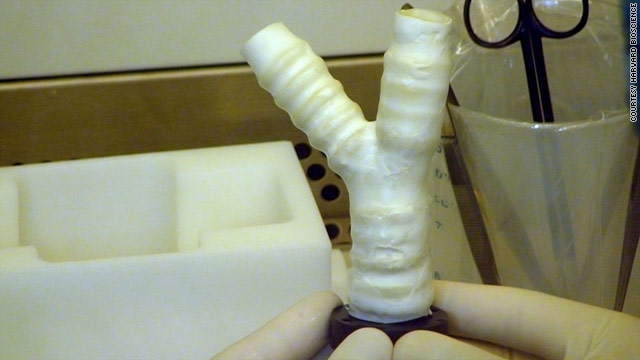
For the first time, a patient has received a synthetic windpipe that was created in a lab with the patient's own stem cells and without using human donor tissue, researchers said Thursday.
Previous lab-generated transplants either used a segment of donor windpipe or involved tissue only, not an organ.
CNN
Subscribe to:
Posts (Atom)