Not long ago I met a filmmaker friend for lunch in the Fisherman's Wharf area of San Francisco, where she was doing some work. She showed up in her sports car with her digital video gear and spent much of our meeting setting it up. At some point she got a call and took it on her BlackBerry. Toward the end of our conversation, I mentioned a new piece of software I had downloaded.
"I don't get that stuff," she nervously confided. "I'm such a Luddite."
Three American "masters of light" who created technologies that made it possible to capture digital images and transmit them and other electronic information long distances today won the 2009 Nobel Prize in physics.
Charles K. Kao, a naturalized American who did most of his work in England and Hong Kong, will share half the $1.4-million prize for demonstrating that highly purified fibers of glass can carry light waves for long distances, setting the stage for the globe-girdling fiber-optic networks that transmit the bulk of everyday television, telephone and other communications.
Willard S. Boyle and George E. Smith, who worked at Bell Laboratories, will share the other half of the award for developing the charge-coupled device, the electronic eye that makes digital photography possible and that in less than two decades has filled the world with inexpensive digital cameras and camera-bearing telephones.
found the bones of all your ghosts Locked in the wishing well While birdsong gourmets dragged empty nets I slumbered in my shell
In mitternacht, die mensch-maschine Kissed me on my eyes I rose and left the fire-ladies Glowing lonely in the night With all the pornographers Burning torches beneath the sea
I want to be a machine I want to be a machine I want to be a machine I want to be a machine
I stole a cathode face from newscasts And a crumbling fugue of songs From the reservoir of video souls In the lakes beneath my tongue In flesh of ash and silent movies I walked at boulevards again A nebula of unfinished creatures From the lifetimes of my friends I hope your innocence has depraved me
I want to be a machine I want to be a machine I want to be a machine I want to be a machine
Broadcast me, scrambled clean Or free me from this flesh Let the armchair cannibals take their fill In every cell across wilderness We'll trip such a strangled tango We'll waltz a wonderland affair Let's run to meet the tide tomorrow Leave all emotion dying there In the star cold beyond all of your dreams
I want to be a machine I want to be a machine I want to be a machine I want to be a machine
When most of us think about a machine composing musical pieces, we think of primitive songs coming out of a HAL 9000 that could be suitable for a child's toy, but nothing that music lovers would actually enjoy. That's because most of us haven't heard of Emily Howell. No, that's not a person—it's the name of a computer program written by University of California, Santa Cruz professor David Cope that, after nearly three decades of work, is about to release, uh, "her" first CD through Centaur Records.
A chip inside the eye that can help blind people see again is moving closer to reality as researchers at MIT work on a retinal implant that can bypass damaged cells and directly offer visual input to the brain.
Have you heard of the "E-Cigarette"? If you haven't and you're a smoker or even a non-smoker, you're seriously missing out! It looks like a cigarette, feels like a cigarette, taste like a cigarette, but isn't! It's so much more! The E-Cigarette is really the healthier future of smoking. This high-tech electronic smoking device provides the nicotine you crave, in a completely non harmful manner! Non-harmful to yourself and to others around you!
Dave, stop. Stop, will you? Stop, Dave. Will you stop, Dave?” So the supercomputer HAL pleads with the implacable astronaut Dave Bowman in a famous and weirdly poignant scene toward the end of Stanley Kubrick’s 2001: A Space Odyssey. Bowman, having nearly been sent to a deep-space death by the malfunctioning machine, is calmly, coldly disconnecting the memory circuits that control its artificial “ brain. “Dave, my mind is going,” HAL says, forlornly. “I can feel it. I can feel it.”
I can feel it, too. Over the past few years I’ve had an uncomfortable sense that someone, or something, has been tinkering with my brain, remapping the neural circuitry, reprogramming the memory. My mind isn’t going—so far as I can tell—but it’s changing. I’m not thinking the way I used to think. I can feel it most strongly when I’m reading. Immersing myself in a book or a lengthy article used to be easy. My mind would get caught up in the narrative or the turns of the argument, and I’d spend hours strolling through long stretches of prose. That’s rarely the case anymore. Now my concentration often starts to drift after two or three pages. I get fidgety, lose the thread, begin looking for something else to do. I feel as if I’m always dragging my wayward brain back to the text. The deep reading that used to come naturally has become a struggle.
It may have a fairy tale ending -- a story of perseverance and second chances that's playing out live on the public stage of online networking.
Brianna Karp's trailer now sits outside a friend's home near Los Angeles
But 24-year-old Brianna Karp's story started as a nightmare.
In a rocky economy, Karp was laid off from her Irvine, California, job as an executive assistant in July 2008.
She got by for a while on temp jobs and unemployment benefits. But when her savings dried up, she was no longer able to afford her rent.
The only answer she saw then was a trailer she'd inherited from her father -- a man she barely knew who had recently committed suicide.
"I was left with a truck and this camper, which I was going to sell but coincidentally this happened to me," she said. "I thought, 'Well, I have this.' "
Karp, who writes that she is also estranged from her mother, ended up camped in a Los Angeles-area Walmart parking lot.
"Perfect" vision could be redefined by gadgets that give you the eyes of a cyborg.The tech industry calls the digital enrichment of the physical world "augmented reality." Such technology is already appearing in smartphones and toys, and enthusiasts dream of a pair of glasses we could don to enhance our everyday perception. But why stop there?
Scientists, eye surgeons, professors and students at the University of Washington have been developing a contact lens containing one built-in LED, powered wirelessly with radio frequency waves.
Eventually, more advanced versions of the lens could be used to provide a wealth of information, such as virtual captions scrolling beneath every person or object you see. Significantly, it could also be used to monitor your own vital signs, such as body temperature and blood glucose level.
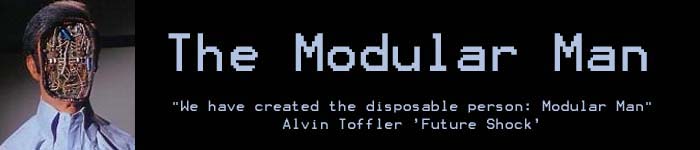
Major Tom:"when i was a younger man than i am now, i picked up a dog eared neon pink copy of toffler's future shock at the goodwill. as i read through it, i was fascinated with his ideas on progress and its affects on humanity. some of it was over the top, and some of it shockingly applicable for our times. the older i get, and the more technology advances, the more a harken back to Toffler's ideas like 'Transience', 'the Modular Man', and 'Future Shock'. i do not claim to have answers to the questions posed in these articles posted here, nor do i wish to direct your opinions. i simply wish to give you, as they give me, pause."